Remediation of contaminated sediments commonly targets the complimentary goals of protecting human health and the environment and restoring impaired environmental resources to beneficial use. Although the selection and implementation of sediment remedies can be straightforward for simple sites, many contaminated sediment sites are challenging from a technical and risk-management perspective.
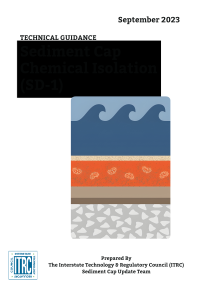
Contaminated Sediments Remediation: Remedy Selection for Contaminated Sediments (CS-2, 2014) offers a remedy selection framework to help project managers evaluate remedial technologies and develop remedial alternatives (often composed of multiple technologies) based on site-specific data. The guidance introduces a six-step remedy selection framework that walks users through reviewing site characteristics, identifying remedial zones, screening and evaluating technologies, developing remedial alternatives, and selecting the best overall remedy while considering factors such as feasibility, cost, and stakeholder concerns. It also provides overviews of monitored natural recovery, in situ treatment, capping, and removal technologies, along with monitoring recommendations and case studies.
Topic(s): Advanced Site Characterization, Complex Sites, In Situ Remediation, In Situ Stabalization, Remediation Technologies, Sediments, Site Characterization, Soils