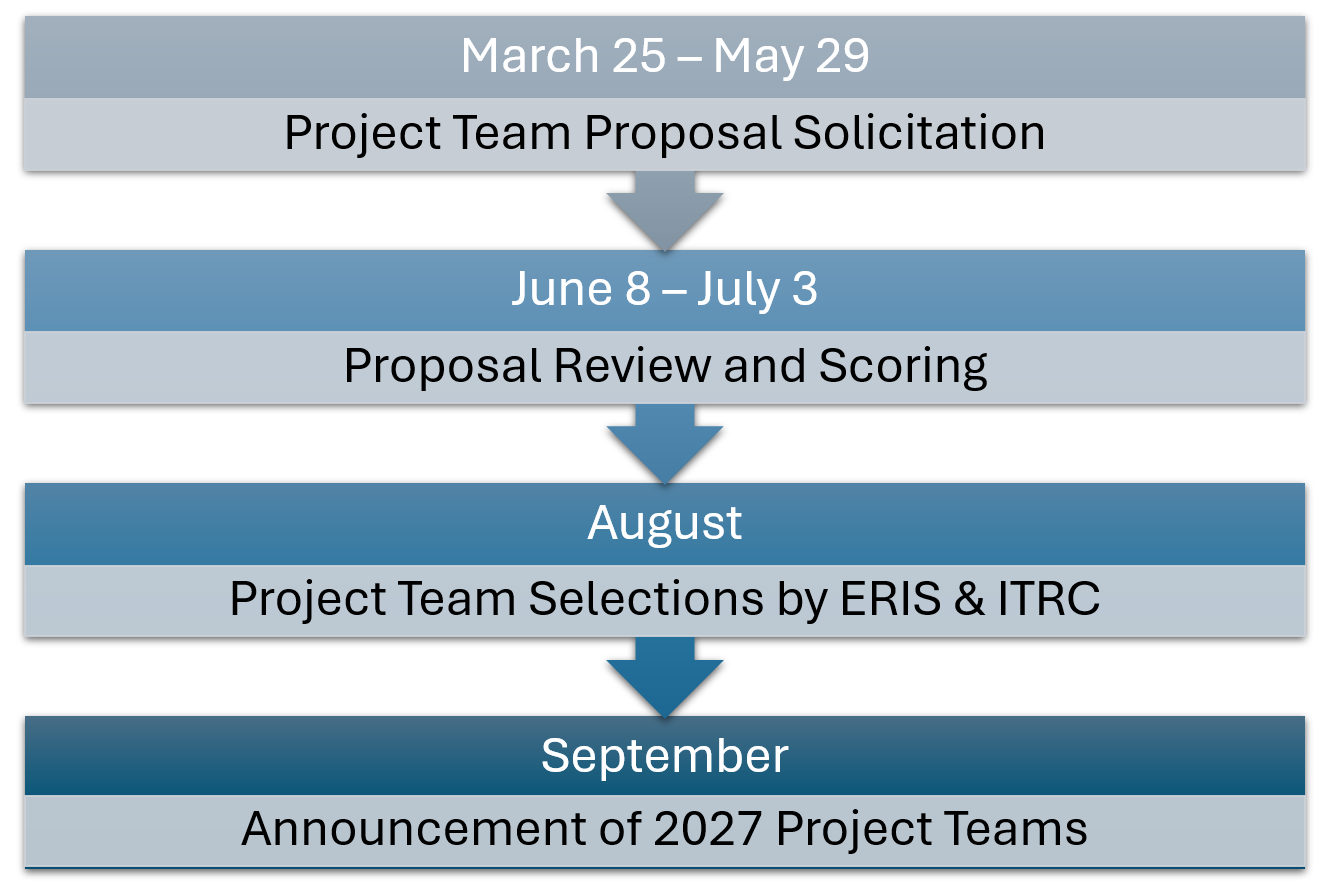
ITRC is accepting proposals for new 2027 Project Teams through May 29, 2026
About ITRC Project Teams
ITRC’s Project Teams are the heart of our organization and bring together members with diverse expertise from state, federal, and other governmental agencies, academia, and the private sector to fulfill our mission, “developing tools and strategies to reduce barriers to the deployment of innovative environmental technologies.”
How to Submit a Proposal
We invite any agency, organization, company or individual to submit a Project Team proposal that will address an environmental topic or challenge.
If a proposal is approved, a Project Team is formed, and ITRC identifies team leadership and necessary contract and staff support, begins team member recruitment, and determines the appropriate schedule and products to be developed.
Project Team proposals must be submitted by email to Charles Reyes at creyes@ecos.org by May 29, 2026 at 5:00 pm ET.
2027 Environmental Topics & Challenges
ITRC staff created the following list of environmental topics and challenges to assist proposal writers. The list below is based on results of the latest Biennial ERIS Survey on State Environmental Agency Research Needs, a 2026 survey of ITRC members and customers, and project proposals submitted to ITRC in recent years. ITRC will consider proposals that address other topics not on this short list.
Click on each general topic area for more details.
- Leachate treatment methods and technologies
- Landfill gas and methane emissions management
- Fire prevention/detection management and mitigation
Updates and addendums to existing ITRC products focused on specific or a group of remediation technologies, optimization and management of contaminated sites. (https://itrcweb.org/guidance-documents)
- “Difficult Pollutants” (i.e., chloride, sulfate, nitrate, perchlorate, etc.)
- Groundwater sampling, monitoring and cleanup
- Harmful Algal Blooms
- Non-point source nutrient reduction
- Produced Water
Addendums to existing ITRC products or new contaminant-specific products focused on sampling, management, risk assessment and treatment technologies, including:
- Asbestos
- Heavy metals
- PFAS
- Plastics – macroplastics, microplastics, nanoplastics
- Radionuclides
- Tire wear particles
- 1,4-Dioxane