Resource Type: Technical Guidance
Determining Cleanup Goals at Radioactively Contaminated Sites: Case Studies
Presents case studies from 12 radioactively contaminated sites to demonstrate variations in the decision-making framework and basis.
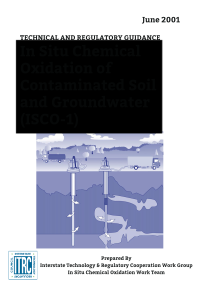
Technical and Regulatory Guidance for In Situ Chemical Oxidation of Contaminated Soil and Groundwater
Includes descriptions of three commonly used chemical oxidants and eight case studies, as well as four examples of state regulatory applications of in situ oxidation.
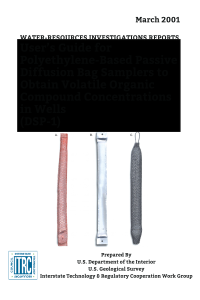
User's Guide for Polyethylene-Based Passive Diffusion Bag Samplers to Obtain Volatile Organic Compound Concentrations in Wells
A jointly developed protocol for determining when, where, and how to use diffusion samplers for groundwater sampling.
Dense Non-Aqueous Phase Liquids (DNAPLs): Review of Emerging Characterization and Remediation Technologies
Review of three general types of emerging dense nonaqueous phase liquid characterization technologies (including geophysical, cone penetrometer, and in situ tracers) and two categories of emerging remediation technologies (thermal enhanced extraction and in situ chemical oxidation).
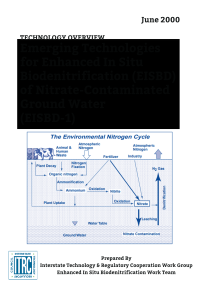
Emerging Technologies for Enhanced In Situ Biodenitrification (EISBD) of Nitrate-Contaminated Ground Water
Provides a description of nitrate in the environment, sources of nitrate, environmental and health effects of nitrate, current nitrate remediation practices, and information on the emerging technology for enhanced in situ biodenitrification.
Design Guidance for Application of Permeable Reactive Barriers for Groundwater Remediation
U.S. Air Force document revised with state input to provide guidance on the design, construction, and monitoring of permeable reactive barriers in various hydrogeologic settings.
Multi-State Evaluation of Elements Important to the Verification of Remediation Technologies
Provides examples of environmental technology verification programs with information about what states and other stakeholders expect from a technology verification effort.
Regulatory Guidance for Permeable Reactive Barriers to Remediate Chlorinated Solvents
A review of regulatory issues, advantages, and disadvantages associated with permeable reactive barriers.
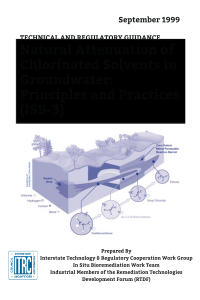
Natural Attenuation of Chlorinated Solvents in Groundwater: Principles and Practices
Describes practices to recognize and evaluate the presence of natural attenuation of chlorinated solvent contamination.
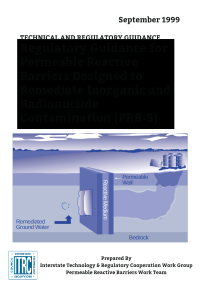
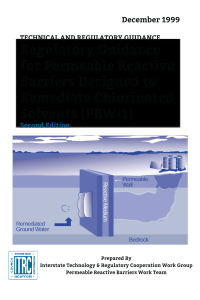
Regulatory Guidance for Permeable Reactive Barriers Designed to Remediate Inorganic and Radionuclide Contamination
Provides regulatory guidelines for the installation of permeable reactive barriers for the remediation of inorganics and radionuclides.