Topic Term: Remediation Technologies
Environmental Molecular Diagnostics: New Site Characterization and Remediation Enhancement Tools
Explains how environmental molecular diagnostic tools can be used to analyze biological and chemical characteristics of samples and support remediation at contaminated sites.
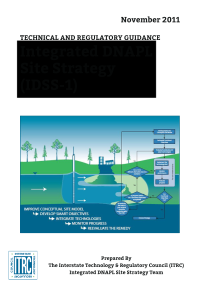
Integrated DNAPL Site Strategy
Guidance to help site managers develop and adapt integrated strategies for understanding, treating, monitoring, and evaluating complex sites contaminated with dense nonaqueous phase liquids.
Environmental Molecular Diagnostics Fact Sheets
Explains key environmental molecular diagnostic tools and how they can be used to better understand contaminants, microorganisms, and environmental processes during site characterization, remediation, monitoring, and closure.
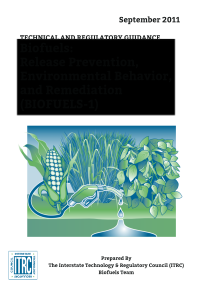
Biofuels: Release Prevention, Environmental Behavior, and Remediation
Framework for preventing, assessing, and responding to biofuel releases, including their environmental behavior, site characterization, and remedial responses.
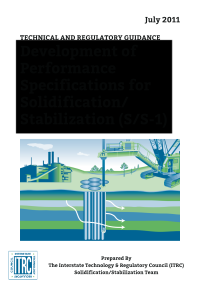
Development of Performance Specifications for Solidification/Stabilization
Explains how to develop and use performance specifications to evaluate the effectiveness of solidification/stabilization remedies, from treatability testing and implementation through long-term monitoring.
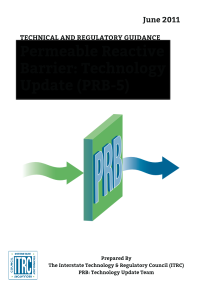
Permeable Reactive Barrier: Technology Update Version 1.01
Guidance to evaluate, design, construct, monitor, and maintain permeable reactive barriers (PRBs) used as treatment zones to clean up contaminated groundwater.
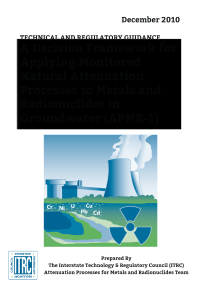
A Decision Framework for Applying Monitored Natural Attenuation Processes to Metals and Radionuclides in Groundwater
Provides a decision framework incorporating key aspects of the EPA’s three-volume technical background series on monitored natural attenuation for metals and radionuclides in groundwater.
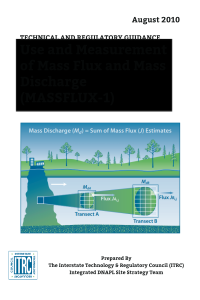
Use and Measurement of Mass Flux and Mass Discharge
Guidance that summarizes the concepts underlying mass flux and mass discharge, their potential applications, and case studies of the uses of these metrics.
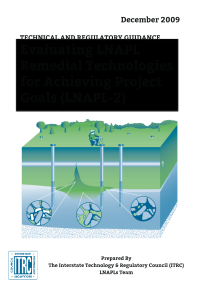
Evaluating LNAPL Remedial Technologies for Achieving Project Goals
Provides a framework for understanding light, nonaqueous-phase liquid (LNAPL) site conditions and selecting the best-suited remedial technology.
Phytotechnology Technical and Regulatory Guidance and Decision Trees, Revised
Practical information on the process and protocol for selecting and applying various phytotechnologies as remedial alternatives.