Topic Term: Site Characterization
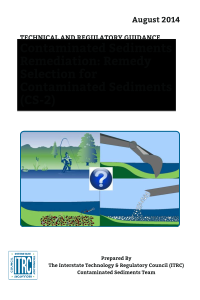
Contaminated Sediments Remediation: Remedy Selection for Contaminated Sediments
Introduces a six-step remedy selection framework to assist decision-makers in identifying which contaminated sediment remedial technology is most favorable for a site.
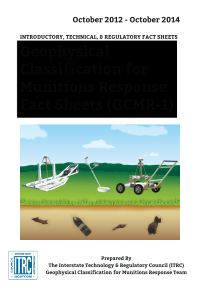
Geophysical Classifications for Munitions Response Fact Sheets
An introduction to geophysical classification for munitions response, including its background, benefits and limitations, regulatory considerations, and technical approaches for identifying buried munitions.
Environmental Molecular Diagnostics: New Site Characterization and Remediation Enhancement Tools
Explains how environmental molecular diagnostic tools can be used to analyze biological and chemical characteristics of samples and support remediation at contaminated sites.

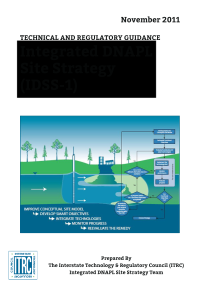
Integrated DNAPL Site Strategy
Guidance to help site managers develop and adapt integrated strategies for understanding, treating, monitoring, and evaluating complex sites contaminated with dense nonaqueous phase liquids.
Environmental Molecular Diagnostics Fact Sheets
Explains key environmental molecular diagnostic tools and how they can be used to better understand contaminants, microorganisms, and environmental processes during site characterization, remediation, monitoring, and closure.

Frequently Asked Questions about Wide-Area Assessment for Munitions Response Projects
Helps project teams determine whether wide-area assessment is appropriate for their projects and, if appropriate, which tools or technologies are most suitable for conducting this within the munitions response area.
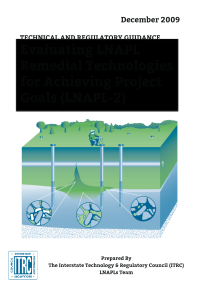
Evaluating LNAPL Remedial Technologies for Achieving Project Goals
Provides a framework for understanding light, nonaqueous-phase liquid (LNAPL) site conditions and selecting the best-suited remedial technology.
The Use of Direct Push Well Technology for Long-Term Environmental Monitoring in Groundwater Investigations
Provides technical and regulatory guidance on using direct push wells for long-term monitoring of groundwater chemistry and static groundwater levels.
Geophysical Prove-Outs for Munitions Response Projects
Provides information on geophysical prove-outs and the broader topics of geophysical surveys, equipment, and methodologies currently used in munitions response actions.
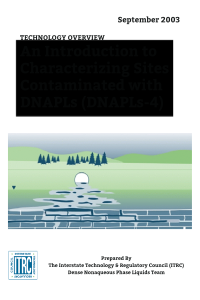
An Introduction to Characterizing Sites Contaminated with DNAPLs
Discusses scientific approaches and strategies used to characterize sites that are known or suspected to be contaminated with dense nonaqueous phase liquids.