Topic Term: Site Characterization
Soil Background and Risk Assessment
This guidance document provides a comprehensive defensible framework for establishing and using soil background in risk assessments.
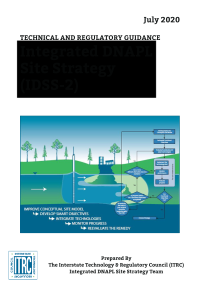
Integrated DNAPL Site Strategy
This updated web-based document assist’s site managers in developing an integrated DNAPL site management strategy.
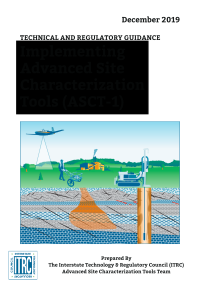
Implementing Advanced Site Characterization Tools
The web-based guidance designed to help state regulators and other practitioners understand, evaluate, and select advanced site characterization tools (ASCTs) to support site conceptual site model and remedial strategy development and refinement.
TPH Risk Evaluation at Petroleum-Contaminated Sites
The ITRC TPH Risk Evaluation at Petroleum-Contaminated Sites guidance builds on long-standing and current research, and presents the current science for evaluating TPH risk at petroleum-contaminated sites.
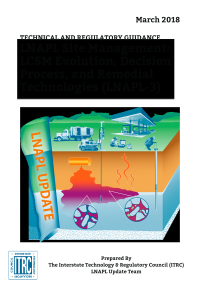
LNAPL Site Management: LCSM Evolution, Decision Process, & Remedial Technologies (LNAPL-3)
Used for any LNAPL site regardless of size and site use and provides a systematic framework: it aids in the understanding, cleanup, and management of LNAPL at thousands of sites with varied uses and complexities
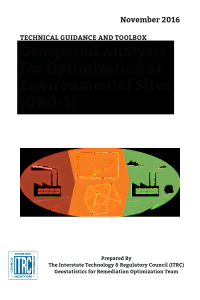
Geospatial Analysis for Optimization at Environmental Sites
The Geospatial Analysis for Optimization at Environmental Sites (GRO-1) web-based guidance is designed to help practitioners better apply geospatial analyses in environmental projects.
Geophysical Classification for Munitions Response
This document explains the process of geophysical classification, describes its benefits and limitations, and most importantly discusses the information and data needed by regulators to monitor and evaluate the use of the technology.
Integrated DNAPL Site Characterization and Tools Selection
This ITRC resource guides environmental professionals through selecting and applying tools for integrated site characterization and remediation at DNAPL-contaminated sites.
Petroleum Vapor Intrusion
This ITRC petroleum vapor intrusion (PVI) guidance document provides an 8-step process for the effective assessment and management of vapor intrusion at sites contaminated with petroleum hydrocarbons. The guidance presents a method of screening petroleum-contaminated sites for potential vapor intrusion and tools and strategies that offer the most efficient means of evaluating the vapor intrusion pathway at these sites. Two checklists are also included as attachments to use in conjunction with the eight-step process to organize and document decisions; one for a single site and one for multiple sites.
Environmental Molecular Diagnostics (EMD) - New Site Characterization and Remediation Enhancement Tools
The Environmental Molecular Diagnostics (EMD) web-based guidance describes a group of advanced and emerging techniques used to analyze biological and chemical characteristics of environmental samples. EMDs have applications in each phase of environmental site management and provide additional lines of evidence for making better decisions. The guidance document provides descriptions of each of the major EMDs, along with case studies of their uses and recommendations regarding the appropriate uses of these techniques. The EMD web-based guidance document will help you to understand how EMDs could benefit your site management decisions.